
Are thermal calculations done in the same way for all building elements?
Generally speaking, yes - all calculations are done by the 'combined method'. However, ground floors differ slightly from other building elements in the information that is required. If requesting a calculation for a ground floor, please ensure that you provide a floor area and length of the exposed perimeter (i.e. the length of new floor along outside-facing walls). This allows us to calculate a perimeter/area ratio, which is crucial in the floor calculation.
Can a breather membrane be laid directly over insulation boards?
Different breather membrane manufacturers have different guidelines for their products, and these should always be consulted prior to installation. It may be possible to lay the breather membrane on the insulation, but with a counter batten airspace above.
If you would like to discuss application of any specific project, please contact our Technical Services.
Can a flat roof survey tell me if my insulation is adequate?
Not necessarily. A visual survey may identify information about the apparent roof build-up, but it cannot reliably confirm the condition, moisture content or thickness of concealed insulation. Where this information is required, further investigation such as core sampling may be necessary. The applicable thermal requirements also depend on factors including the building, the work being undertaken and which Building Regulations provisions apply.
Can I get a U-value calculated for my flat roofing project?
Absolutely! Please contact our freephone technical helpline on 01543 678777.
Can I recess cables into PIR insulation boards?
Cables should not be recessed into the insulation boards. They may be laid between two layers of boards with the cabling oversized to accommodate for an increase in operating temperature. If cables penetrate an insulation layer, PIR will have no detrimental effect on cable sheathing.
Further guidance on the above should be obtained from a qualified electrician.
Can I walk on Deck-VQ® vacuum insulation panels?
Yes, this is possible due to the protection layers in high density PIR and the compressive strength of 150 kPa (CS(10\Y)150). Deck-VQ® is suitable for application in flat roofs and terraces, subject to light foot traffic.
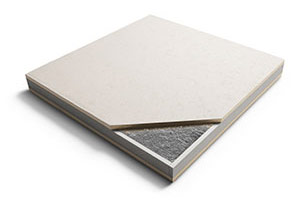
As for every type of insulation, we recommend to limit the foot traffic during installation to a minimum and apply the waterproofing as soon as possible after installation. It is best practice to only install the area you are able to insulate AND waterproof in one day.
Can tapered insulation be used on an existing flat roof?
Yes. Tapered insulation can be designed for both new and existing roofs.
For refurbishment projects, the existing roof construction should be assessed before a tapered insulation scheme is designed. The survey and design should consider the existing roof dimensions, drainage points, falls, obstructions, roof condition and the proposed new roof build-up.
Can you drill, nail or saw into a Vacuum Insulation Panel?
No, because these actions will lead to the loss of vacuum in the VIP and reduce the thermal performance by a factor of three*.
Our Deck-VQ® concept offers an optimum protection to prevent most damage on site. (see “What is the difference between Deck-VQ® and a Vacuum Insulation Panel?”).
Our technical services provide guidance and deliver a detailed design for your project.
Do not hesitate to contact us for further information.
*The thermal conductivity of the core material rises to ca. 0,020 W/mK under ambient pressure.
Do I need an intrusive survey or core samples?
Not every roof survey requires intrusive investigation. If the purpose is to identify visible defects or drainage issues, a visual assessment may be sufficient. However, where the condition of the underlying roof build-up, moisture levels or insulation needs to be established, intrusive investigation may be recommended. The appropriate scope will depend on the condition of the roof and the reason for the survey.
Does thicker insulation always provide better thermal performance?
Increasing insulation thickness will generally increase the thermal resistance of the insulation layer, but thickness alone does not determine the thermal performance of a complete roof.
The thermal conductivity of the insulation, the other components within the roof build-up and the construction details all contribute to the final U-value.
Different insulation materials can therefore achieve similar thermal performance at different thicknesses.
This is particularly relevant where roof build-up height is restricted, because high-performance insulation can help achieve a required thermal target without simply increasing the thickness of conventional insulation.